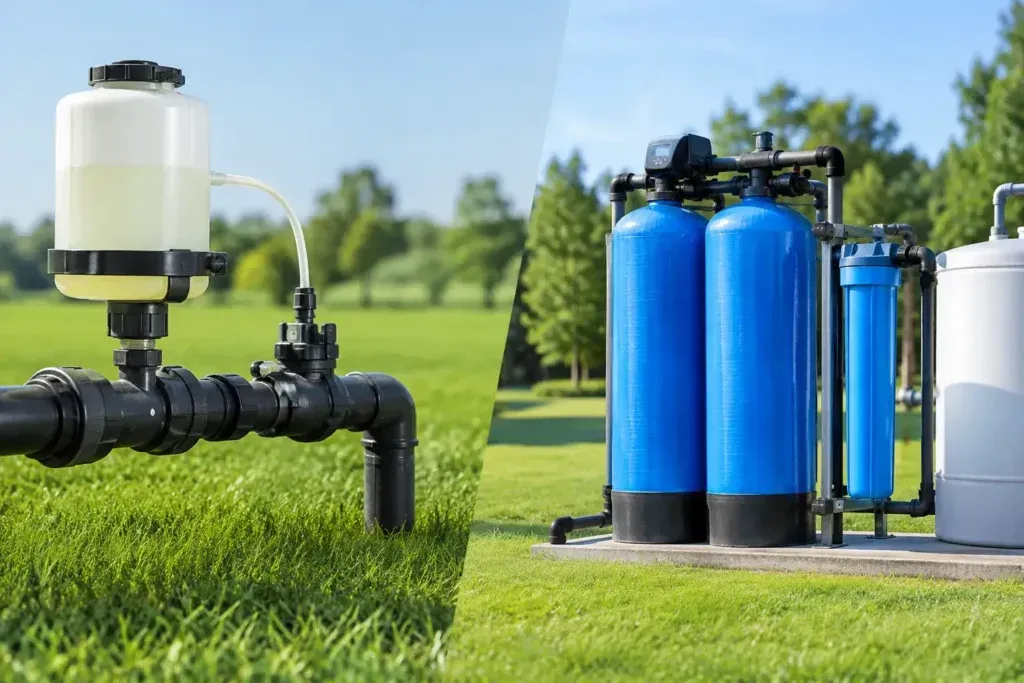
An injector manifold is where a fertigation program becomes a controlled nutrient-delivery system instead of a tank-and-pump setup. This injector manifold guide explains how the manifold coordinates multiple fertilizer, acid, and additive inputs so turf and crops receive the intended recipe at the intended rate. For operations responsible for premium playing surfaces, high-visibility landscapes, or intensive growing areas, that level of control directly affects plant response, input waste, labor, and budget.
A properly configured manifold allows managers to apply frequent, light nutrient doses through irrigation water while keeping products separated until injection. That matters when programs call for different N-P-K ratios, micronutrients, pH adjustment, iron, wetting agents, or season-specific materials. Rather than building a program around the limitations of one premixed tank, the manifold gives the operation a practical way to manage a recipe.
What an Injector Manifold Does
An injector manifold is the organized assembly of injection points, check valves, isolation valves, piping, gauges, and related controls that connects nutrient sources to the irrigation supply. In a multi-injector fertigation system, each injector typically draws from its own stock solution tank and feeds the mainline through the manifold.
The central purpose is simple: deliver each product accurately, safely, and consistently while maintaining proper water flow and protecting the irrigation supply. The manifold is not just plumbing. It is the distribution and control center that lets a manager combine compatible inputs in precise proportions without forcing every product into the same concentrate tank.
For a golf course, that may mean independently controlling nitrogen, potassium, micronutrients, and acidification. A sports field manager may prioritize quick-response nutrition and color while managing water windows around events. A greenhouse or agricultural operation may need tighter control of EC, pH, and crop-stage nutrient ratios. The hardware is similar, but the recipe, injector count, monitoring needs, and operating schedule should fit the site.
Why Multiple Injectors Change the Program
Single-injector systems can work well when the nutrient program is straightforward and a single compatible stock solution meets the need. The trade-off is flexibility. Once products are combined in one tank, changing one element of the recipe can require reformulating the entire batch. Some materials also should not be concentrated together because they can react, precipitate, or lose effectiveness.
A manifold with multiple injectors keeps separate products separate until they enter the irrigation stream. That lets the operator adjust one nutrient source without disturbing the rest of the program. If tissue tests, soil conditions, water quality, weather, or growth goals change, the recipe can change with them.
This approach is especially valuable where conditions vary across the calendar. Spring recovery, summer stress management, fall rooting, and winter color programs do not require the same nutrient balance. A multi-injector manifold makes those adjustments operationally realistic, rather than a labor-intensive tank-mixing exercise.
Turf Feeding Systems configures two-, four-, five-, and eight-injector systems because the right number depends on the materials an operation needs to control independently. More injectors create greater recipe flexibility, but they also add initial investment, tank space, calibration requirements, and program-management responsibility. The goal is not to install the highest injector count possible. It is to specify enough independent channels to support the agronomic plan without paying for unnecessary complexity.
The Components That Protect Accuracy
An effective injector manifold depends on several components working together. The injectors meter product, but dependable performance also relies on the supporting hardware and controls around them.
Injection Points and Check Valves
Each injection line needs a properly designed injection point and check valve arrangement. Check valves help prevent irrigation water from backing into chemical lines and help prevent one product from migrating into another source tank. This is essential for safety, product integrity, and consistent application.
Backflow protection should be selected and installed according to applicable codes and site conditions. This is not an area to treat as optional. A well-designed manifold protects both the irrigation system and the operator managing it.
Isolation Valves and Service Access
Isolation valves allow one injector line to be shut down for maintenance, calibration, or a product change without taking the entire system out of service. Easy access matters more than it may appear during system selection. If routine service requires disassembling multiple lines or working around crowded fittings, maintenance tends to be delayed.
Manifold layouts should leave room for technicians to inspect fittings, confirm valve positions, service injectors, and trace each line from tank to injection point. Clear labeling is equally useful when several concentrates are in use.
Flow, Pressure, pH, and EC Monitoring
Injection accuracy begins with stable system operation, but verification requires measurement. Flow monitoring confirms the water volume moving through the system. That figure is fundamental because nutrient rates are tied to the amount of water being treated.
Pressure readings help identify restrictions, changes in irrigation demand, or conditions that may affect injection performance. In applications where water chemistry and nutrient concentration matter, pH and EC monitoring add another layer of control. pH management can improve nutrient availability and help prevent scaling or incompatibility issues. EC provides a practical indicator of dissolved salts in the irrigation water, allowing growers and turf managers to verify that the delivered solution is aligned with the program target.
Neither pH nor EC replaces a complete nutrient analysis, but both give operators useful real-time feedback. They turn fertigation from a set-it-and-forget-it process into a measured application program.
Selecting the Right Injector Manifold Configuration
The best injector manifold begins with the program, not a catalog specification. Start by identifying which products must remain independent. Consider macronutrients, micronutrients, acids, biologicals, colorants, wetting agents, and any products that cannot be mixed at concentrate strength.
Next, evaluate irrigation flow range. An injector system must perform across the actual flows the site experiences, not only at a theoretical maximum. A course may operate different station groups with significantly different demands. A landscape contractor may manage multiple properties with varying mainline capacity. A growing operation may use short, frequent cycles with narrow control tolerances. The manifold and injectors need to be sized for those conditions.
Water quality should also influence the specification. Hard water, high alkalinity, suspended solids, and source-water variability can affect nutrient solubility, acid demand, filtration needs, and maintenance intervals. An operation that ignores water chemistry may still inject fertilizer, but it may not achieve the consistency or efficiency expected from a precision system.
Finally, consider who will run the equipment. A highly automated multi-injector system can reduce manual mixing and improve repeatability, but staff still need a clear calibration process, tank-handling procedures, and a method for reviewing system data. The best configuration is one the team can operate correctly every week of the season.
Calibration Is Where Manifold Performance Is Proven
Even well-designed equipment requires calibration. Injection rates should be verified at commissioning and checked on a defined schedule, especially after maintenance, product changes, or major shifts in water flow. A small rate error repeated through many irrigation cycles can become a meaningful nutrient and cost variance over a season.
Calibration should compare the programmed rate to the actual volume delivered over a measured period. It should also confirm that each injector is drawing from the correct tank, each valve is functioning, and the final application matches the intended water volume. Record the results. A simple service log helps identify trends before they become expensive problems.
Managers should also inspect filters, suction lines, fittings, tubing, check valves, and tank levels routinely. Air leaks, clogged strainers, worn seals, and crystallized fertilizer residue can reduce accuracy or stop injection altogether. Preventive maintenance is far less disruptive than troubleshooting during an irrigation window.
Operational Benefits Beyond Fertilizer Application
A correctly specified injector manifold supports a different way of managing plant nutrition. Instead of relying primarily on large, periodic dry applications that can be lost to runoff, volatilization, uneven distribution, or poor timing, fertigation delivers nutrients with the water already moving to the root zone.
That can reduce fertilizer and chemical use by 50% or more in the right application while supporting consistent turf density, color, recovery, and root development. Because nutrients are applied in smaller, more frequent doses, plants have more opportunities to use them. Well-managed fertigation programs can deliver up to 95% of nutrients to the plant, reducing waste and the environmental burden associated with excess application.
Water management benefits as well. When nutrient delivery is coordinated with irrigation scheduling, managers can avoid unnecessary watering simply to move dry fertilizer into the soil. For large properties, the combination of lower inputs, reduced labor, and more efficient water use can create significant annual savings. The exact return depends on acreage, current practices, water source, fertilizer costs, and the level of control required.
Build the Manifold Around the Outcome
An injector manifold should make a nutrient program easier to execute, verify, and refine. If a system cannot maintain accurate ratios, accommodate the required products, or provide operators with meaningful feedback, it will limit the results the agronomic program can achieve.
The practical next step is to map the materials you use, the flow conditions you manage, and the measurements you need to see. From there, the right manifold configuration becomes clear: one that delivers healthier plants with less waste, more control, and a program your team can confidently run season after season.