A clogged nozzle bank, uneven precipitation, and rising fertilizer costs often point back to the same source: water chemistry. The acid injection versus water treatment decision is not simply a choice between two pieces of equipment. It is a decision about which water problem is limiting irrigation performance, nutrient efficiency, and turf quality across the property.
For golf, sports turf, landscape, and growing operations, source water can carry bicarbonates, hardness minerals, iron, sediment, salts, or biological contaminants. Each creates a different operational risk. Acid injection can be highly effective when alkalinity and carbonate scale are the primary issues, but it is not a complete substitute for filtration, softening, disinfection, or other water-treatment methods. The strongest programs begin with a water analysis and build treatment around the actual constraint.
Acid Injection Versus Water Treatment: The Operational Difference
Acid injection is a targeted form of water conditioning. An acid is metered into irrigation water to reduce pH and, more significantly, neutralize alkalinity. In high-bicarbonate water, this reduces the calcium carbonate precipitation that can form scale in pumps, filters, valves, laterals, emitters, and sprinkler components.
The practical benefit extends beyond cleaner irrigation hardware. High alkalinity can push root-zone pH upward over time, particularly in sand-based systems and container production. That shift can reduce the availability of iron, manganese, phosphorus, and other essential nutrients. Properly managed acid injection helps keep irrigation water and nutrient solutions in a range that supports more predictable nutrient uptake.
Water treatment is the broader category. It may include sediment filtration, media filtration, screen or disc filtration, iron removal, water softening, oxidation, reverse osmosis, disinfection, or blending. These methods address contaminants that acid cannot solve. Acid does not remove suspended solids, lower sodium, eliminate chloride, or make saline water suitable for sensitive crops. It also does not provide reliable pathogen control.
The distinction matters because a low pH reading alone does not mean water is ready for irrigation or fertigation. pH measures active acidity at the moment of testing. Alkalinity measures the water’s ability to resist a pH change, largely because of bicarbonates and carbonates. A source may show a moderate pH yet still carry enough alkalinity to create scale and elevate root-zone pH. Conversely, a low-alkalinity source may need little or no acid even if its pH appears higher than expected.
What Each Approach Solves
| Operational issue | Acid injection | Broader water treatment | |—|—|—| | High bicarbonate alkalinity | Directly effective when properly sized and controlled | May be paired with acid treatment, but not usually the primary correction | | Carbonate scale in irrigation equipment | Helps prevent new scale and can gradually address light deposits | Filtration protects equipment from particles but does not neutralize alkalinity | | Sand, silt, and organic debris | Does not remove it | Filtration is the appropriate first line of defense | | Iron, manganese, and biological fouling | May influence precipitation behavior but is not a complete solution | Oxidation, filtration, and disinfection may be required | | High sodium, chloride, or salinity | Does not remove dissolved salts | Blending, reverse osmosis, or source management may be necessary | | Nutrient-solution pH control | Effective as part of a measured fertigation program | Treatment protects the water supply but may not control final nutrient-solution pH |
This is why acid injection should be viewed as precision chemistry, not a universal fix. It changes the chemistry of the water moving through the system. Water treatment removes, separates, neutralizes, or manages contaminants based on their physical, chemical, or biological characteristics.
When Acid Injection Is the Better Investment
Acid injection earns its place when a water report shows elevated alkalinity and field conditions support that finding. Repeated scale at injector fittings, clogged emitters, white mineral deposits around sprinkler heads, declining distribution uniformity, and persistent micronutrient deficiencies despite adequate applications are all signals worth investigating.
It is particularly valuable in operations using frequent, light fertigation. Small nutrient doses applied through irrigation can improve consistency and reduce the losses associated with large, infrequent dry applications. But the advantage depends on keeping nutrients soluble from the tank through the point of discharge. High-pH, high-alkalinity water can work against that goal by increasing the risk of precipitation and reducing nutrient availability after application.
Acid can also improve compatibility within a nutrient program, but it must be managed carefully. Calcium products can react with phosphate or sulfate materials, and concentrated stock solutions need to be kept compatible before they ever reach the irrigation line. Acidifying the final irrigation stream is not a license to mix incompatible products in one tank.
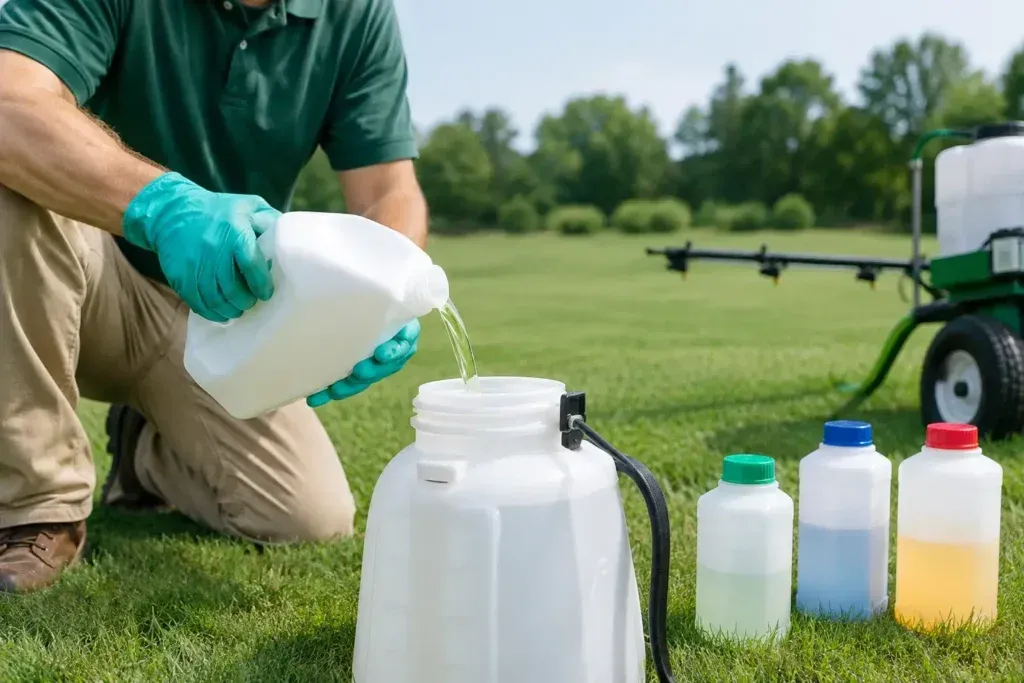
The correct acid type, injection rate, and point of injection depend on water chemistry, flow rate, irrigation materials, fertilizer sources, and the desired final pH and alkalinity. Over-acidification can corrode equipment, stress plants, and create serious worker-safety concerns. Acid storage, secondary containment, chemical-resistant components, backflow protection, calibration, and documented operating procedures are not optional details.
When Water Treatment Must Come First
If the main issue is physical debris, start with filtration. Trying to solve sediment loading with acid is ineffective and can create a more complicated maintenance problem. Filters should be selected for the water source, particle size, flow demand, and acceptable pressure loss, then monitored so that backflush cycles do not compromise irrigation capacity.
If dissolved salts are high, acid injection will not reduce the electrical conductivity of the source water. In fact, certain acid choices add ions to the water, which may matter where nutrient and salinity budgets are tight. Sodium and chloride require a separate management strategy, often involving source blending, drainage planning, leaching requirements, or more advanced treatment.
Water containing iron, sulfur compounds, algae, or bacterial slime may need oxidation, filtration, or disinfection. These problems can plug emitters and create uneven application even when alkalinity is well controlled. In those cases, acid injection may become one part of the solution, but it should not be expected to replace the treatment train.
For a high-value sports field, golf course, greenhouse, or estate, the cost of misdiagnosis is larger than the cost of a complete water test. Analyze pH, alkalinity, hardness, EC, sodium, chloride, iron, manganese, bicarbonate, suspended solids, and microbial risk where relevant. Compare the report with actual system symptoms and irrigation performance before selecting equipment.
Build Chemistry Control Into the Fertigation System
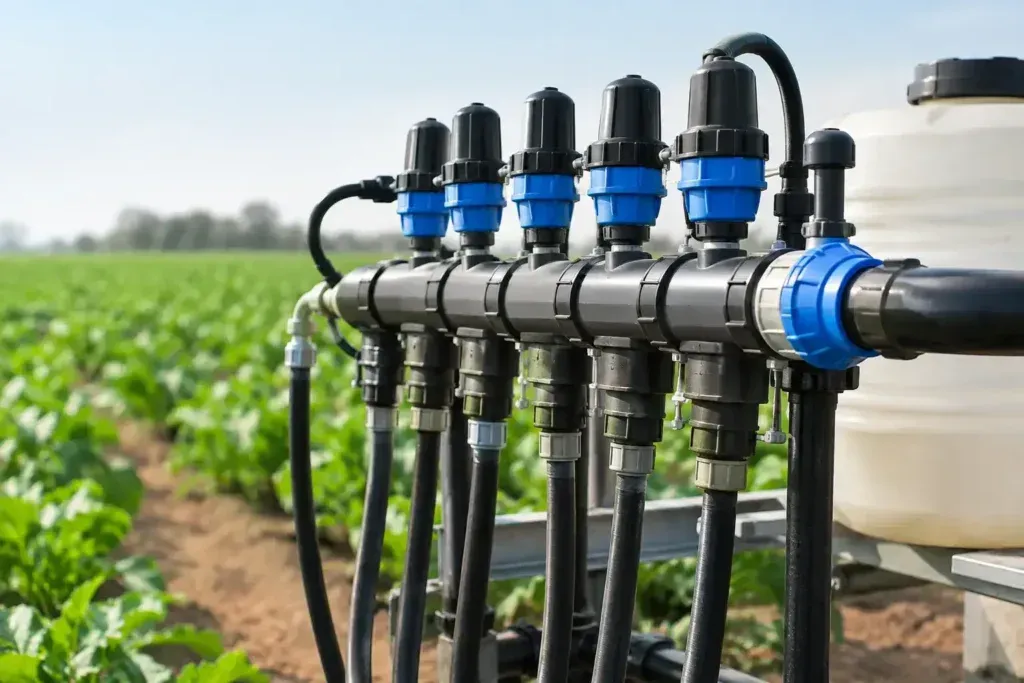
The most efficient operations do not treat water chemistry and nutrient delivery as separate conversations. They manage them together. A configured injection system can meter acid and nutrients independently, allowing the operator to maintain a specific nutrient recipe while adjusting water chemistry based on changing source conditions, seasonal demand, and crop or turf response.
That separation is especially useful when a property applies nitrogen, potassium, micronutrients, wetting agents, and pH correction on different schedules. Multiple injectors make it possible to keep incompatible materials apart, change rates without hand mixing, and avoid applying products that are not needed on a particular irrigation cycle. Flow, pH, EC, and PPM monitoring turn these decisions from assumptions into measurable control points.
Turf Feeding Systems designs configurable multi-injector fertigation equipment for this level of management. In the right application, frequent, controlled delivery can reduce fertilizer and chemical use by 50% or more while directing a much higher percentage of applied nutrients to the plant. The savings come from preventing excess application, reducing labor-intensive dry spreading, protecting irrigation performance, and applying only what the growing environment requires.
That does not mean every operation needs acid injection. A low-alkalinity water source with clean filtration and stable nutrient performance may not justify it. Likewise, an operation with severe salinity may need source-water treatment before precision injection can deliver the expected agronomic result. The equipment should follow the water analysis and management objective, not the other way around.
A Practical Decision Process
Start by defining the observed problem. Is the concern clogged nozzles, mineral scale, inconsistent turf color, nutrient tie-up, high labor costs, salt stress, or poor distribution uniformity? Then verify the cause with laboratory water data and field measurements rather than relying on pH alone.
Next, separate the requirements into protection and production. Protection includes filtration, scale prevention, corrosion management, and backflow safeguards. Production includes nutrient solubility, root-zone pH management, application timing, nutrient ratios, and consistent coverage. A well-designed system addresses both without adding unnecessary chemical or equipment complexity.
Finally, establish operating targets and verify them at the point that matters: the water delivered to the field or growing zone. Monitor source conditions, injected rate, flow, final pH, EC, pressure, and distribution. Seasonal shifts in water supply or source blending can change the program, so calibration and review should be routine parts of irrigation management.
The best answer is rarely acid injection alone or water treatment alone. It is the right level of water conditioning, filtration, and precision fertigation for the conditions on the property. When the water is understood and every input is metered with purpose, healthier turf and stronger plant performance become a controlled operating result rather than a costly correction.