A cloudy stock tank, sediment at the bottom of a tote, or a plugged injector can turn a precise nutrition program into an expensive service call. This nutrient compatibility testing guide explains how turf and growing professionals can verify fertilizer, water, and chemical combinations before they enter a fertigation system. The goal is straightforward: keep nutrients soluble, protect equipment, and deliver the intended recipe uniformly across every irrigated zone.
Compatibility testing is not just a chemistry exercise. It is an operational safeguard for golf courses, sports fields, landscapes, horticultural operations, and controlled growing environments where nutrient accuracy affects color, density, recovery, yield, labor, and budget.
Why nutrient compatibility matters in fertigation
Fertigation works best when nutrients remain dissolved from the stock solution through injection, irrigation water, and distribution to the root zone. When products react in a concentrated tank or after dilution in the mainline, they can form precipitates. Those solids may settle in tanks, clog strainers and check valves, foul flow meters, restrict emitters, and create uneven feeding.
The agronomic cost can be just as significant. If calcium, phosphorus, iron, sulfur, or micronutrients become unavailable through precipitation, the program applied in the field may no longer match the recipe calculated at the beginning of the day. A course superintendent may see inconsistent turf response between zones. A grower may see unexplained nutrient deficiencies despite maintaining the expected injection rate and parts-per-million targets.
The risk depends on more than the fertilizer label. Source-water alkalinity, hardness, bicarbonates, pH, temperature, concentration, and the order of mixing all influence whether a blend stays stable. A combination that appears acceptable in a low-concentration irrigation stream can fail immediately when stored together in a concentrated stock tank.
The chemistry behind common incompatibilities
Most compatibility problems involve ions combining to form an insoluble compound. Calcium is a frequent concern because it readily reacts with phosphates and sulfates. Calcium nitrate and a phosphate fertilizer may each be valuable parts of a feeding program, but putting them into the same concentrated stock tank can create a calcium phosphate precipitate. The same concern applies to calcium and sulfate-containing products.
Hard water adds another variable. Calcium and magnesium already present in the irrigation supply can react with phosphate, carbonate, sulfate, and some micronutrient sources. High bicarbonate water can also push pH upward, making iron, manganese, zinc, and copper less available or more likely to fall out of solution.
pH management deserves particular attention. Acid injection can reduce bicarbonates and help maintain a more favorable water pH, but acid should never be treated as a universal fix for incompatible fertilizers. Adding acid to a tank without understanding the full formulation can cause a reaction, create excessive heat, release fumes, or damage components. Always follow product labels and safety data requirements.
Chelated micronutrients require their own review. The chelate type determines how well a nutrient remains available across a given pH range. A micronutrient blend that performs well in mildly acidic water may lose stability in high-pH irrigation water. Compatibility is therefore a question of both physical solubility and nutrient availability.
Nutrient compatibility testing guide: the jar test
A jar test is the most practical first screen for a proposed fertigation recipe. It does not replace supplier guidance or a full water analysis, but it can identify obvious precipitation before expensive materials enter your tanks and irrigation system.
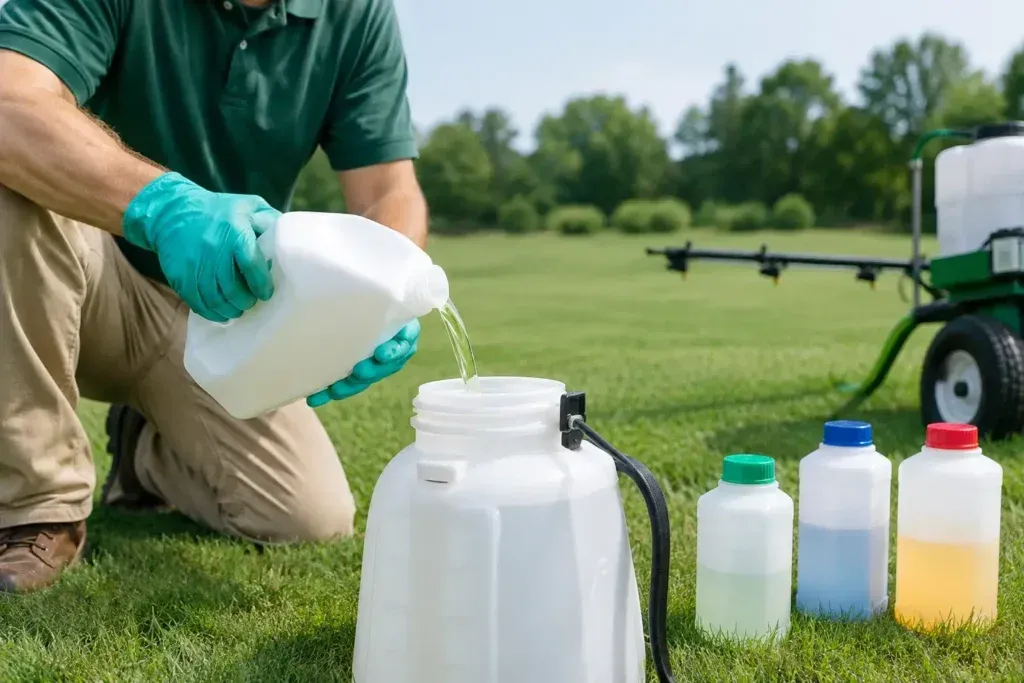
Start with clear glass jars, clean measuring tools, personal protective equipment, and water taken from the actual irrigation source. Do not use distilled water unless that is what the operation will inject into. Source water carries the hardness, alkalinity, and pH conditions that often cause the problem.
Use the same proportional concentration planned for the system. If two products will be stored separately and injected independently, test them that way as well as in the expected diluted irrigation-water concentration. This distinction matters. Two products may remain stable after entering the irrigation line but be unsuitable for the same stock tank.
Add materials in the same order planned for mixing. Dissolve dry products completely before adding another material. When testing liquids, add each product slowly while stirring gently. Record the product names, rates, lot numbers, water temperature, starting pH, and the order of addition. This documentation makes it easier to repeat a successful recipe and identify the cause of a failed one.
Observe the sample immediately, then again after 15 minutes, one hour, and 24 hours. Cloudiness, flakes, crystals, settling, heat, gas formation, color changes, or a film on the glass all signal that the mix needs further review. Compare the test jar with a control jar containing only the source water.
A clear jar is encouraging, but it is not automatic approval. Some reactions develop slowly, while others occur only under pressure, at higher tank concentrations, or when water temperature changes. Treat the jar test as a disciplined screening step within a larger compatibility process.
Test the water before changing the recipe
A current irrigation-water analysis is the foundation of a dependable fertigation program. At minimum, review pH, electrical conductivity, alkalinity, bicarbonates, calcium, magnesium, sodium, chloride, sulfate, iron, and manganese. For intensive growing programs, also evaluate seasonal variation and any differences between wells, surface water, reclaimed water, or municipal supplies.
Water quality can change throughout the year. A recipe that runs cleanly in spring may become problematic during a hot, dry period when well-water chemistry shifts or a different supply source comes online. Retesting is particularly valuable when an operation changes fertilizer suppliers, adopts a new acidification strategy, adds a micronutrient package, or notices residue in tanks and filters.
EC and pH monitoring provide useful operational feedback, but they do not identify every incompatibility. EC can confirm that dissolved salts are entering the irrigation stream at a consistent general concentration. It cannot confirm that each individual nutrient remains available. Pair real-time measurements with periodic water testing, calibrated injection equipment, and field observation.
Separate stock tanks when chemistry requires it
The most reliable answer to many compatibility problems is not forcing a blend to work. It is separating incompatible materials into dedicated stock tanks and injecting them independently. Calcium-based fertilizers are commonly held apart from phosphate and sulfate sources. Acid products may also require their own compatible tank, fittings, and injection path.
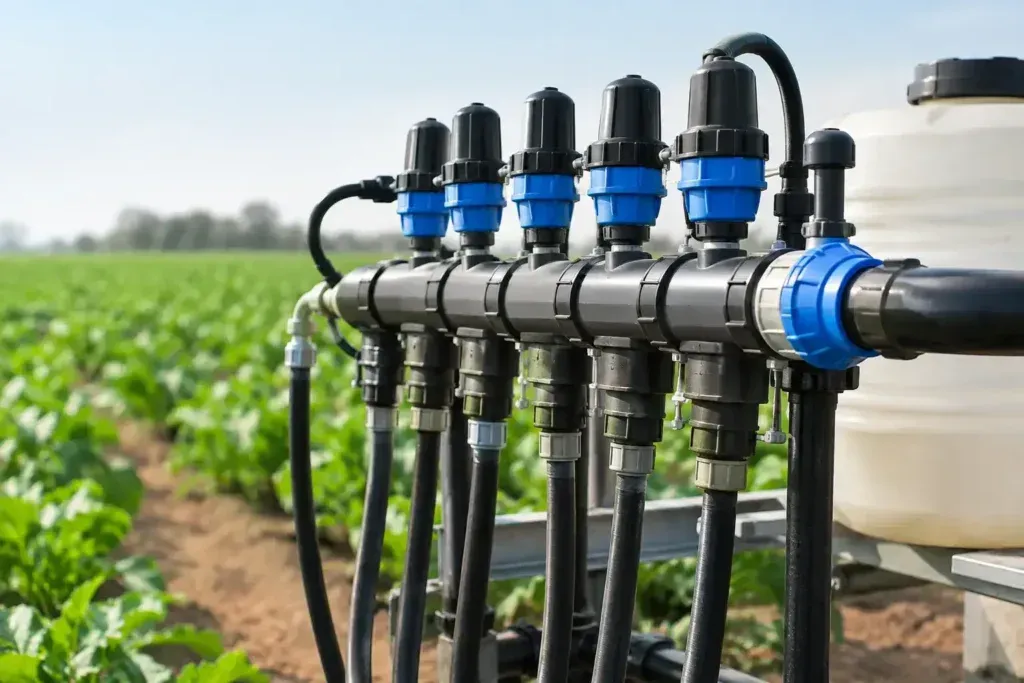
This is where multi-injector fertigation equipment creates practical control. Independent injectors allow an operation to maintain separate nutrient concentrates, apply the intended ratios, and avoid reactions that occur when materials are combined prematurely. A two-injector configuration may fit a straightforward program, while four-, five-, or eight-injector systems can support more complex recipes, micronutrients, acid management, and crop or turf-specific adjustments.
Separation does add equipment and management considerations. More tanks require labeling, inventory control, calibration, and operator training. For high-value turf or intensive production, however, that added control can cost far less than clogged infrastructure, wasted fertilizer, inconsistent plant response, and repeated corrective applications.
Protect the system after a successful test
A compatible recipe still needs sound system practices. Keep stock tanks covered and agitated as appropriate for the formulation. Use clean water for tank makeup. Inspect suction lines, foot valves, filters, strainers, injection points, and check valves on a defined schedule. Flush lines with clean water after injection, especially when a product leaves residue or the system will sit idle.
Calibration is equally important. Verify actual injector output rather than relying only on setpoints. Compare drawdown from the stock tank with expected consumption, check flow performance under normal operating pressure, and confirm that EC, pH, and PPM readings align with the intended program. If field results do not match the recipe, investigate water quality, injector calibration, and precipitation before increasing fertilizer rates.
Turf Feeding Systems designs configurable fertigation equipment around this kind of operational discipline: accurate injection, separate nutrient management, and measurable control over pH, EC, flow, and nutrient delivery.
When to involve a fertilizer or equipment specialist
Some blends deserve more than a jar test. Seek technical review when using acids, highly concentrated stock solutions, reclaimed water, unusual micronutrient packages, biological additives, pesticides, or formulations from multiple manufacturers. The same applies when residue has already appeared in tanks or emitters, or when a new program is being deployed across a large acreage or a high-value growing environment.
Bring the complete picture to that conversation: water analysis, fertilizer labels, target injection rates, tank sizes, existing equipment, and desired nutrient concentrations. A compatibility decision made with these details is more reliable than one based on product names alone.
The best fertigation programs do not ask one tank to hold every input. They use tested water, compatible formulations, proper separation, and verified injection rates to put nutrients where they create value: consistently in the plant root zone, rather than in the bottom of a tank or the inside of an irrigation line.