A fertigation program can have the right fertilizer analysis, injector ratio, and irrigation schedule on paper yet still deliver uneven results in the field. The weak point is often the tank. To optimize stock solution mixing , professional turf and growing operations must produce a uniform, compatible concentrate that remains stable from the first irrigation cycle to the last.
That matters because a stock tank is not simply a place to dissolve fertilizer. It is the source material for every injected dose. If solids settle, products react, concentration drifts, or water quality changes the solution, the injector can only meter inconsistency with great precision. The result may be clogged components, nutrient imbalance, variable color, reduced growth response, and unnecessary chemical loss.
Optimize Stock Solution Mixing Before Injection Begins
Stock solution quality begins with the application target. Start with the nutrient rate needed at the plant, the irrigated acreage or growing area, expected runtime, and the system’s injection ratio. From there, calculate the required concentrate strength and determine whether that concentration is soluble and stable at the operating temperature.
This sequence prevents a common operational mistake: mixing the tank first and trying to make it fit the injection system afterward. A concentrate that is too weak may require excessive tank volume and frequent refilling. One that is too strong may crystallize, settle, or exceed a product’s solubility limit. The best concentration is not necessarily the highest possible concentration. It is the concentration that stays homogeneous, injects accurately, and supports the desired feeding interval.
For golf, sports turf, landscapes, and high-value growing operations, frequent light applications are usually the operational advantage. Properly mixed stock solutions allow nutrients to move with irrigation water in controlled doses, rather than relying on large dry applications that can sit on the surface, move off target, or become unavailable before roots can use them.
Confirm product compatibility first
Not every fertilizer, micronutrient, acid, biological product, or plant protection input belongs in the same tank. Compatibility depends on the materials involved, their concentration, source-water chemistry, temperature, and the final solution pH.
Calcium-containing materials deserve particular attention. When combined with incompatible phosphate or sulfate sources in concentrated form, they can form insoluble precipitates. Those solids may not be obvious immediately. They can develop over time in the tank, suction line, filters, injection manifold, or emitters. The operational cost is more than a clogged line. It is lost application uniformity when the system is needed most.
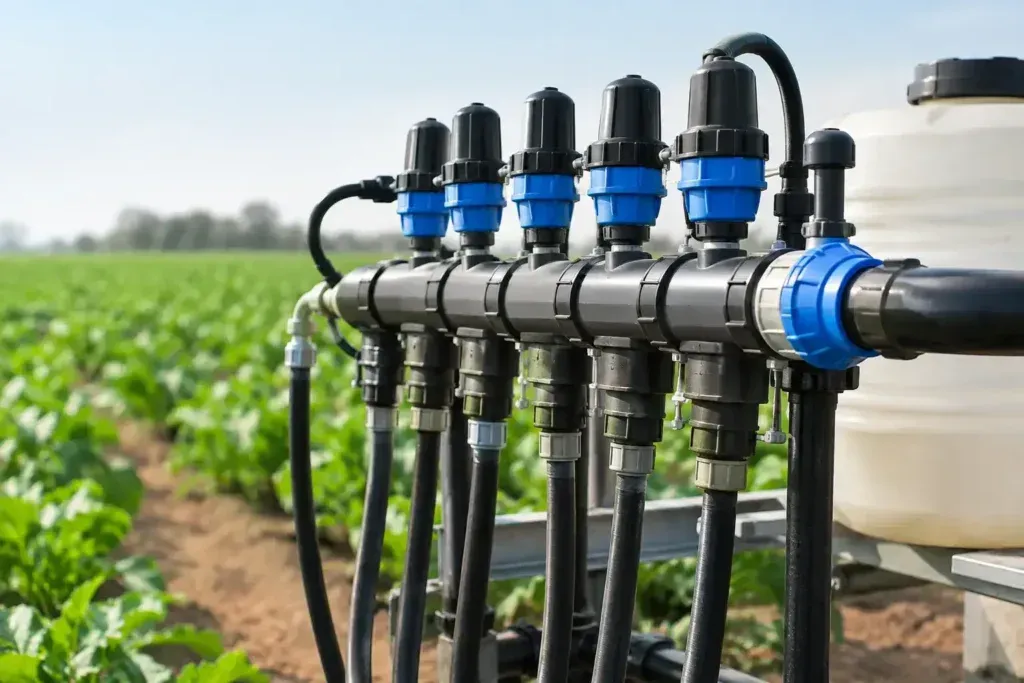
Use separate stock tanks and injectors when chemistry requires separation. Configurable multi-injector systems make that practical by allowing nutrients, acids, and specialty products to remain isolated until dilution in the irrigation stream. A two-injector configuration may suit a straightforward program, while four-, five-, or eight-injector systems give complex turf and horticultural recipes the control they require.
When introducing a new combination, perform a small-scale jar test using the same water source and proportional concentrations planned for the tank. Check for cloudiness, heat, sediment, layering, or crystals immediately and again after the solution sits. A jar test does not replace product-label guidance, but it can expose a costly incompatibility before it reaches the irrigation network.
Start With Water, Not Just Fertilizer
Water quality can determine whether a stock solution stays stable. Hardness, alkalinity, iron, manganese, suspended solids, and water temperature all influence mixing performance. The same formulation may behave differently between a municipal source, a well, a pond, and reclaimed water supply.
High-bicarbonate water can push pH upward and complicate nutrient availability. Hard water can contribute calcium and magnesium that react with certain products. Water carrying sediment can accelerate filter loading and create a false impression that the fertilizer itself is not dissolving.
Test the source water routinely, not only when commissioning a system. Seasonal changes, well performance, and source changes can alter the chemistry enough to require a revised acid program, different product sequence, or a lower concentrate strength. Monitoring pH and EC at the tank and irrigation line gives operators a more immediate view of whether the intended recipe is reaching the system.
Water temperature also affects solubility. A concentrate that is clear in a warm mixing room can crystallize overnight in a cold equipment area. Conversely, heat can shorten the useful life of certain biological or specialty materials. Account for the lowest likely storage temperature when setting tank concentration, especially for seasonal turf operations.
Use the Right Mixing Sequence and Agitation
Mixing order is a control point, not a minor housekeeping step. Fill the tank partially with clean water before adding dry or liquid products. Begin agitation, add one material at a time, and allow each product to dissolve or disperse fully before introducing the next. Complete the fill volume only after the formulation is stable.
Adding fertilizer into an empty tank, or dumping multiple products together before adequate dilution, creates concentrated contact zones where reactions and clumping are more likely. It can also leave dense material packed at the tank bottom, beyond the effective reach of a small recirculation loop.
Agitation should match the material and tank design. Fully soluble mineral fertilizers may need steady recirculation to maintain uniformity, particularly in larger tanks or during long irrigation windows. Suspensions and products with heavier particles often demand more vigorous agitation and closer maintenance attention. Excessive agitation, however, may foam certain products or damage sensitive biological inputs. The correct approach depends on the chemistry, not a one-setting-fits-all rule.
Position the tank outlet and suction pickup so settled material is not ignored. A system that draws only from the upper portion of the tank can inject a weak solution early and a concentrated solution later. Tank geometry, mixer location, and pickup placement should work together to keep the entire volume representative.
Verify What the System Is Actually Delivering
A clear tank does not guarantee accurate fertigation. Verification should include the concentrate and the diluted irrigation water. Measure stock-tank EC and pH after mixing, then compare readings at the irrigation line during injection. Flow monitoring confirms whether the system is delivering the expected water volume, while injector calibration confirms that the concentrate is entering at the intended rate.
EC is useful for spotting concentration changes, but it is not a complete nutrient analysis. Two recipes can produce similar EC readings while containing very different nutrient ratios. Use EC as an operating indicator alongside documented formulation calculations, periodic water analysis, and field response.
PPM targets should be tied to the crop or turf objective, not treated as a universal score. A putting green, a high-traffic athletic field, an ornamental landscape, and a controlled-environment crop can require different nitrogen rates, nutrient balances, and feeding frequencies. Precision means delivering the planned program consistently, then adjusting based on tissue response, soil or media conditions, weather, and performance expectations.
Build calibration into routine maintenance
Injection equipment can drift as seals wear, filters load, pressure conditions change, or operators modify irrigation schedules. Confirm injector output on a routine schedule and after any repair, formulation change, or major change in runtime. Track tank drawdown against expected consumption. If the tank level falls faster or slower than calculated, investigate before the variation becomes a plant-health issue.
Inspect filters, check valves, suction strainers, mixer operation, and tank cleanliness at the same time. Sediment in a tank may indicate poor dissolution, a compatibility issue, inadequate agitation, or contamination from the water source. Treat it as diagnostic evidence rather than a cleaning inconvenience.
Design the Mixing Program Around Operating Reality
The most efficient mixing program is one the crew can repeat accurately under real working conditions. That means clear batch formulas, marked tank volumes, documented mixing order, labeled tanks, and a simple log for product lot, water volume, EC, pH, date, and operator. These practices reduce dependence on memory and make troubleshooting far faster.
For operations managing multiple zones or plant types, separate recipes can protect both agronomic performance and budget. There is little value in sending a premium micronutrient package to every acre if only specific areas need it. Multiple injectors allow managers to target nutrition, acidification, and specialty inputs with more discipline while reducing excess application.
Turf Feeding Systems engineers packaged fertigation equipment around this kind of control: accurate injection, configurable nutrient channels, and monitoring that ties chemistry back to field performance. When stock solutions are stable and metered correctly, operations can apply nutrients in smaller, better-timed doses, reduce fertilizer and chemical waste by 50% or more in appropriate programs, and direct more of every purchased input toward the plant.
A well-mixed tank will not replace sound agronomy, but it gives the fertility program a dependable starting point. Make every batch measurable, compatible, and repeatable, then let plant response guide the next adjustment. That is how a stock solution becomes a practical tool for stronger turf, more predictable growth, and lower operating waste.